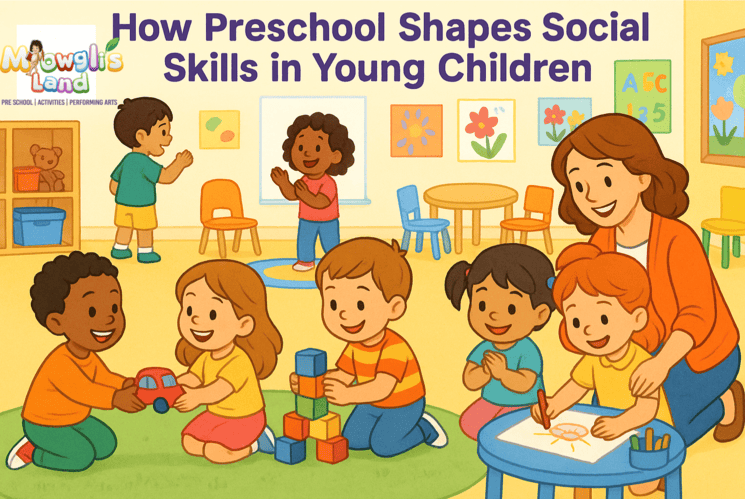
Preschool isn’t just about learning letters and numbers—it’s where the roots of strong social skills begin to grow. At Mowgli’s Land School in Bhopal, we understand that developing healthy social habits early in life leads to better emotional intelligence, communication, and cooperation as children grow.
1. Introduction
Social development during the preschool years is foundational for a child’s future. It determines how well they form relationships, resolve conflicts, and behave in group settings. Preschool becomes the first structured environment outside the home where children interact regularly with peers and non-family adults. These early experiences lay the groundwork for social success.
At Mowgli’s Land School, our curriculum and environment are designed not just to educate, but to foster empathy, collaboration, and confidence in every child.
2. The Importance of Social Skills in Early Childhood
Social skills are vital for a child’s emotional well-being and academic success. Children with good social skills tend to:
- Form lasting friendships
- Have higher self-esteem
- Cope better with frustration and challenges
- Express themselves more clearly
- Collaborate effectively with peers
Without these skills, children may feel isolated, anxious, or struggle to adjust in group situations like school and later workplaces.
Early childhood is when children begin to understand and navigate complex emotions such as jealousy, embarrassment, pride, and empathy. Having a solid social framework enables them to handle these emotions in a constructive manner.
3. How Preschool Environments Encourage Social Growth
Preschool introduces children to:
- Structured settings with routines and rules that promote predictability and order
- Peer groups of similar ages and varying personalities, encouraging diversity in interaction
- Group dynamics, such as waiting for turns, listening to others, and sharing materials
- Problem-solving opportunities that arise naturally from social interaction and conflict
At Mowgli’s Land, we ensure our environment supports spontaneous social play alongside guided activities. Children are encouraged to express themselves in multiple ways—through words, art, movement, and music—building well-rounded communication.
4. Key Activities That Build Social Skills
Circle Time
Children take turns talking, practice listening, and build verbal confidence. Sharing thoughts in a respectful, structured manner fosters empathy, communication, and patience.
Role Play and Dramatic Play
Pretend scenarios allow children to rehearse real-life social situations. Through play-acting roles like parent, teacher, or doctor, they explore empathy, negotiation, leadership, and cooperation.
Collaborative Art and Building Projects
Working on group projects teaches patience, taking turns, appreciating different perspectives, and achieving shared goals. These are critical components of team-building and leadership development.
Outdoor Games and Free Play
Outdoor play brings out natural leadership, compromise, and the concept of fairness. Through physical games and team sports, children learn how to work together, compete respectfully, and resolve disputes independently.
Story Time Discussions and Emotion Charts
Books are powerful tools for developing empathy. Children discuss characters’ feelings and motives, building their ability to read emotional cues. Emotion charts help children recognize and verbalize their own feelings.
5. The Role of Teachers in Social Development
Teachers act as role models and coaches. At Mowgli’s Land, our educators:
- Demonstrate courteous, respectful interactions
- Use gentle conflict resolution strategies
- Acknowledge and validate children’s feelings
- Reinforce positive behaviors like sharing, helping, and including others
- Provide structured group tasks and reflect on social behavior after completion
Teachers also maintain close communication with parents to ensure that the child’s social development at school aligns with their home experiences.
6. Handling Conflicts and Emotions in Preschool Settings
Social conflict is natural in early childhood. We teach children that conflict is not something to fear—it’s something to manage constructively.
We use:
- Restorative conversations to help children understand the impact of their actions
- Guided peer mediation to resolve conflicts in peaceful ways
- Calm-down corners where children learn self-soothing techniques
- Feelings charts to build emotional vocabulary
This helps develop emotional regulation, patience, and accountability.
7. The Influence of Peer Interaction on Personality Development
Frequent peer interaction helps shape a child’s personality. Outgoing children learn how to take turns and share leadership. Introverted children gradually build confidence in expressing themselves. Children exposed to diversity in the classroom grow more accepting and open-minded.
Peer bonds often become the first non-familial relationships that children deeply value, helping them learn mutual trust, loyalty, and cooperation.
Preschool becomes a mini-community where children experiment with roles, identities, and perspectives in a safe and guided space.
8. Long-Term Benefits of Strong Social Skills
The social skills learned in preschool have life-long benefits:
- Academic Excellence: Cooperative learning environments benefit those with strong communication and group work capabilities
- Emotional Intelligence: Children better understand themselves and others
- Resilience: They handle challenges and changes more easily
- Professional Success: Teamwork, empathy, and conflict management are critical in adulthood
- Healthier Relationships: Children learn to nurture and maintain friendships, and communicate effectively with family and partners
9. Why Mowgli’s Land is Ideal for Your Child’s Social Growth
At Mowgli’s Land School in Bhopal, we:
- Provide a nurturing and safe community
- Train teachers in social-emotional learning and positive discipline
- Use child-centered methods to build autonomy and empathy
- Offer programs tailored for all personality types—introverted, sensitive, active, or outgoing
We believe every child is capable of growth, and our programs are designed to meet them where they are, helping them become confident, kind, and socially capable individuals.
10. Conclusion
Preschool is more than just preparation for academics—it’s a transformative experience that shapes who your child becomes. With the right environment, mentors, and peers, your child will not only learn how to count or read—but also how to care, collaborate, and connect.
At Mowgli’s Land School, we take pride in shaping not just students—but compassionate citizens and future leaders.