1. Introduction
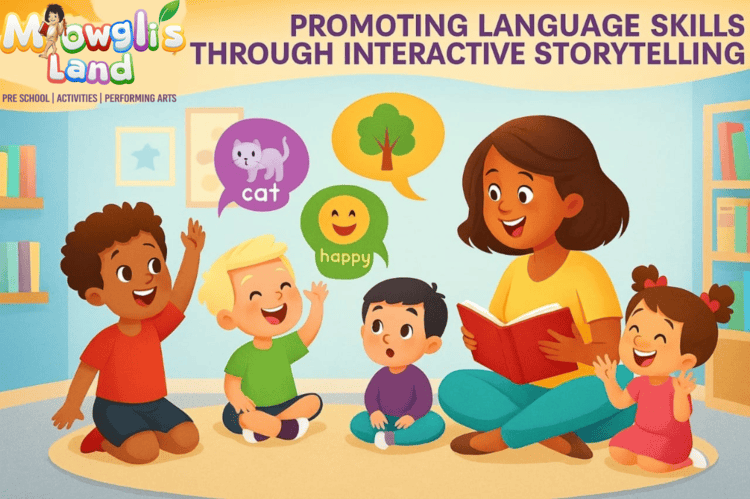
At Mowgli’s Land Preschool, we understand that preschool language development lays the foundation for lifelong learning, social interaction, and academic success. From a child’s first babbles to full sentences, mastering vocabulary, sentence structure, and expressive skills is vital. One of the most engaging and effective ways to promote language skills in preschoolers is through interactive storytelling. Rather than passive listening, interactive storytelling transforms storytime into a dynamic, child-centered learning activity. Children not only listen—they become co-creators: they ask questions, predict outcomes, and shape the narrative. In this blog, we’ll explore why interactive storytelling is essential for language acquisition, share practical techniques to make storytime engaging, and provide step-by-step activities you can implement both at home and in our preschool classrooms.
2. Why Interactive Storytelling Matters for Preschool Language Development
Engagement and Attention
- Interactive vs. Passive:
When stories are simply read aloud, children may hear new words but not fully process their meaning. By contrast, pausing to ask questions like, “What do you think the rabbit will do next?” turns them into active participants. This increased engagement helps with vocabulary retention and deepens comprehension.
- Multisensory Input for Deeper Learning:
Using puppets, props, and illustrations stimulates not just listening but also sight and touch. When children can hold a soft toy or point to an illustrated character, they access multiple pathways for absorbing new language concepts.
Building Vocabulary and Syntax
- Natural Context for New Words:
Instead of teaching a list of isolated vocabulary, interactive stories embed words within meaningful sentences. Hearing terms like “dazzling,” “crouch,” or “flutter” in context helps preschoolers understand both definition and usage.
- Modeling Complex Sentence Structures:
Through storytelling, children overhear varied grammar patterns—questions, exclamations, compound sentences. Over time, they begin to imitate these structures. For example:
-
- “The tiny mouse scurried beneath the log.”
- “Why did the knight leap over the dragon?”
Encouraging Expressive Language
- Prediction and Retelling:
Asking, “What do you think happens next?” encourages children to form sentences and express ideas in their own words. After the story, prompting them to retell key events (“First, the bear hid; then…”) reinforces sequencing language—“first,” “next,” “finally.”—and helps solidify comprehension.
- Role-Playing and Voice Modulation:
When a child becomes “Princess Ellie” or “Captain Leo,” they practice tone, volume, and emotional expression. Assigning characters encourages kids to experiment with different voices—learning how emphasis and intonation change meaning.
3. Techniques to Make Storytime Interactive
3.1 Use Open-Ended Questions
- Avoid yes/no questions such as, “Do you see the cat?” Instead, ask:
- “Why do you think the cat is hiding behind the tree?”
- “If you were the little rabbit, what would you do if it started to rain?”
- “How is this playground in the story similar to our school playground?”
- “Why do you think the cat is hiding behind the tree?”
- Open-ended prompts spark critical thinking, develop narrative skills, and encourage children to speak in complete sentences.
3.2 Incorporate Props and Visual Aids
- Puppets:
Transform a simple sock puppet into “Max the Monkey,” who “asks” the children to guess the next part of the story. Puppets make characters feel real and invite kids to join the dialogue.
- Story Stones or Picture Cards:
Use smooth stones painted with images (dog, tree, sun) or laminated cards. Children can hold up a stone to indicate which character speaks next or use picture cards to sequence events.
- Costume Pieces:
Even a colorful scarf can become a magical cape. When a child dresses up, they “become” the character and narrate part of the story—building confidence and expressive language.
3.3 Interactive Reading Strategies
- Choral Reading:
Encourage all children to repeat refrains or phrases together: “The lion roared, ROAR!” Repetition reinforces rhythm, phonemic awareness, and intonation.
- Echo Technique:
Teacher reads a line—“The rainbow stretched across the sky”—and the class echoes it. This helps solidify sentence structure and pronunciation.
- Fill-in-the-Blank:
Pause at predictable points: “The mouse says, ‘_____, _____, _____.’” Invite kids to shout “Cheese, cheese, cheese!” This builds anticipation and vocabulary recall.
4. Activity 1: Puppet-Assisted Storytelling
Objective
Enhance vocabulary, practice conversational turns, and build confidence speaking in front of peers.
Materials Needed
- A small collection of hand puppets (homemade sock puppets or store-bought).
- A large picture book with simple, colorful illustrations (for example, a story about forest friends on an adventure).
Steps
- Introduction (2–3 Minutes):
-
-
- Present each puppet, give it a name, and describe its personality. Example: “This is Flora the Fox—she’s curious and brave.”
- Present each puppet, give it a name, and describe its personality. Example: “This is Flora the Fox—she’s curious and brave.”
-
- Story Setup (2 Minutes):
-
-
- Explain that Flora the Fox will narrate the story but will occasionally “ask” questions. Children should listen for Flora’s questions and answer together.
- Explain that Flora the Fox will narrate the story but will occasionally “ask” questions. Children should listen for Flora’s questions and answer together.
-
- Interactive Reading (8–10 Minutes):
-
-
- Read the story using the puppet’s voice. When Flora “goes off-script,” ask, “Flora wants to know—why did Sam the Squirrel hide behind the log?”
- Encourage a child whose hand is raised to hold Flora and ask the next question in their own words.
- Read the story using the puppet’s voice. When Flora “goes off-script,” ask, “Flora wants to know—why did Sam the Squirrel hide behind the log?”
-
- Role Swap (5 Minutes):
-
-
- Offer puppets to volunteers. In pairs or small groups, they retell a short paragraph using the puppets—practicing both vocabulary and dialogue.
- Offer puppets to volunteers. In pairs or small groups, they retell a short paragraph using the puppets—practicing both vocabulary and dialogue.
-
- Debrief (2–3 Minutes):
-
- Ask, “Which new words did we learn today? Who can use ‘scurry’ or ‘emerge’ in a sentence?” Record responses on a chart labeled “New Words” to reinforce retention.
- Ask, “Which new words did we learn today? Who can use ‘scurry’ or ‘emerge’ in a sentence?” Record responses on a chart labeled “New Words” to reinforce retention.
Benefits
- Children practice turn-taking and conversational dialogue (“My puppet says…”).
- Using different voices and expressions helps with voice modulation and emotional literacy.
- Passing the puppet to peers fosters peer modeling and builds confidence in speaking.
5. Activity 2: Story Stones and Story Mats
Objective
Encourage creative sentence construction, narrative sequencing, and collaborative storytelling.
Materials Needed
- Story Stones: Smooth stones painted with simple images—sun, tree, boat, dog, house, heart, star, etc. (Use acrylic paint or permanent markers.)
- Story Mats: Placemats or large butcher paper divided into three panels labeled “Beginning,” “Middle,” and “End.” Alternatively, use “Problem,” “Action,” and “Solution.”
Steps
- Preparation (Before Class):
-
-
- Scatter a set of story stones in the center of a low table or place them in a basket. Put one story mat in front of each small group (3–4 children).
- Scatter a set of story stones in the center of a low table or place them in a basket. Put one story mat in front of each small group (3–4 children).
-
- Stone Selection (3 Minutes):
-
-
- Each child picks two stones at random without looking. For example, one child picks “rainbow” and “cat,” another picks “key” and “castle.”
- Each child picks two stones at random without looking. For example, one child picks “rainbow” and “cat,” another picks “key” and “castle.”
-
- Beginning Creation (3 Minutes):
-
-
- Children discuss and decide how to start: “Once upon a time, a cat saw a rainbow that led to a magical key.” Write or draw this sentence in the “Beginning” panel.
- Children discuss and decide how to start: “Once upon a time, a cat saw a rainbow that led to a magical key.” Write or draw this sentence in the “Beginning” panel.
-
- Middle Development (5 Minutes):
-
-
- Introduce a challenge: “But the key was stuck behind a locked castle gate.” Each child takes turns adding a sentence, which is recorded in the “Middle” panel.
- Introduce a challenge: “But the key was stuck behind a locked castle gate.” Each child takes turns adding a sentence, which is recorded in the “Middle” panel.
-
- Ending Resolution (4 Minutes):
-
-
- Conclude together: “The cat meowed for help, a friendly mouse came, and together they used the key to open the gate.” Write or draw this in the “End” panel.
- Conclude together: “The cat meowed for help, a friendly mouse came, and together they used the key to open the gate.” Write or draw this in the “End” panel.
-
- Share Out (3 Minutes per Group):
-
- Each group presents their illustrated mat to the class. Other children ask follow-up questions: “Why did the mouse help the cat?” or “Where did the rainbow come from?”
- Each group presents their illustrated mat to the class. Other children ask follow-up questions: “Why did the mouse help the cat?” or “Where did the rainbow come from?”
Benefits
- Encourages use of complete sentences and new vocabulary (e.g., “magical,” “locked,” “gate”).
- Reinforces sequencing words—“first,” “next,” “finally”—building narrative skills.
- Promotes cooperative speaking, active listening, and peer collaboration.
6. Activity 3: Collaborative Story Creation Circle
Objective:
Develop listening comprehension, turn-taking, flexibility in narrative flow, and spontaneous speech.
Materials Needed:
- A large, comfortable sitting area arranged in a circle.
- A simple prop to pass around (for example, a plush toy representing the “storyteller token”).
- Optionally, a flip chart or whiteboard to jot down keywords during storytelling.
Steps
- Warm-Up (2 Minutes):
-
-
- Begin with a prompt: “Today, let’s tell a story about a magical garden.” Ask children to close their eyes and visualize the setting.
- Begin with a prompt: “Today, let’s tell a story about a magical garden.” Ask children to close their eyes and visualize the setting.
-
- Token Introduction (1 Minute):
-
-
- Explain that whoever holds the plush toy gets to add one sentence to the story, then passes the token to the next friend. Each sentence must connect logically to the previous one.
- Explain that whoever holds the plush toy gets to add one sentence to the story, then passes the token to the next friend. Each sentence must connect logically to the previous one.
-
- Circle Storytelling (8–10 Minutes):
-
-
- Teacher starts: “Once upon a time, in a garden full of glowing flowers…” and hands the token to the child on the right.
- Child 1: “Lived a tiny butterfly named Luna who loved to explore.” Pass token.
- Child 2: “One day, Luna discovered a hidden path behind a big sunflower.” And so on.
- Encourage children to use transition words: “However,” “Suddenly,” “Meanwhile.”
- Teacher starts: “Once upon a time, in a garden full of glowing flowers…” and hands the token to the child on the right.
-
- Visual Aid (Optional):
-
-
- As key ideas emerge (for example, “butterfly,” “hidden path,” “sunflower”), jot them on the flip chart so children can reference them and maintain continuity.
- As key ideas emerge (for example, “butterfly,” “hidden path,” “sunflower”), jot them on the flip chart so children can reference them and maintain continuity.
-
- Conclusion (2 Minutes):
-
- Once the token returns to the teacher, summarize the final sentence: “At last, Luna found a secret door that led her back home, where she told all her friends about the magical garden.”
- Once the token returns to the teacher, summarize the final sentence: “At last, Luna found a secret door that led her back home, where she told all her friends about the magical garden.”
Benefits:
- Children practice active listening—if they miss a point, they refer to keywords or ask peers to repeat.
- Turn-taking teaches patience, respect, and collaboration.
- Flexible thinking: if one child introduces a “storm,” the story pivots, and everyone adapts—reinforcing narrative flexibility and creativity.
7. Practical Tips for Parents and Teachers
Create a “Word Wall” or “Story Corner”:
- Dedicate a small space in the classroom or home to display new vocabulary on laminated cards with pictures on one side and the word on the other.
- Rotate featured words weekly based on the stories you read. For instance, after a story about farm animals, display “barn,” “moo,” “tractor,” and “harvest.” This constant visual reinforcement supports vocabulary acquisition.
Link Stories to Real-Life Experiences
- If a story involves planting seeds, take children outside to plant actual seeds. Describe each step—“We dig a hole, plant the seed, cover it with soil.” This hands-on approach connects story vocabulary (“plant,” “grow,” “garden”) to real actions.
- When reading about cooking or baking, involve children in preparing a simple snack: “Let’s spread jam on bread.” They hear and use words like “spread,” “slice,” and “stir,” reinforcing cooking vocabulary.
Encourage Home–School Connections:
- Share story ideas or puppet-making instructions with parents via a weekly newsletter or WhatsApp group. Provide a printable list of recommended stories and interactive prompts.
- Invite families to submit favorite family tales—grandparents’ folk stories or simple anecdotes. Feature one family narrative each week and let children ask questions: “Why did Grandpa choose apples for the pie?” This promotes cultural literacy and strengthens parent–teacher partnerships.
Use Audiovisual Aids Sparingly:
- While short animated videos can be engaging, prioritize live, interactive experiences. If you show a brief cartoon version of a story, pause frequently to ask:
- “What’s happening here?”
- “Why do you think Tim the Turtle looks sad?”
- These pauses maintain active engagement and ensure children aren’t just passively watching.
8. Observing Progress and Celebrating Milestones
Key Indicators of Language Growth
- Expanded Vocabulary:
Children begin using words they’ve only previously heard in stories—words like “emerge,” “inspect,” or “cautiously.”
- Longer Utterances:
A 3-year-old who once spoke in two-word phrases (“big dog”) now constructs short sentences: “The big brown dog barked loudly.”
- Improved Listening Comprehension:
During circle time, children accurately recall story details: “Remember when Luna met the mouse? What did the mouse say?”
- Increased Enthusiasm for Storytelling:
A child volunteers to “read” a picture book to peers, even if they “invent” some words—showing confidence in using language creatively.
Documenting Progress
- Anecdotal Records:
Keep brief weekly notes. For example: “Riya used the word ‘adventure’ correctly when describing the story.” Over time, these notes reveal clear growth in language complexity.
- Story Retell Journals:
Provide each child with a simple drawing journal. After a story, they draw a favorite scene and dictate a sentence or two describing it. Comparing journal entries over weeks helps track improvements in sentence length and detail.
- Language Goals Meetings:
During parent–teacher conferences, share short audio clips or transcripts from storytelling circles. Concrete examples—“See how Arjun now uses transition words like ‘first’ and ‘then’”—help parents appreciate subtle advances in their child’s language development.
9. Conclusion: A Fresh and Fun Experience
Interactive storytelling at Mowgli’s Land Preschool is far more than just a fun activity—it’s a powerful strategy for accelerating preschoolers’ language skills. By embedding new words in rich, meaningful contexts; encouraging children to ask questions, predict outcomes, and role-play; and providing hands-on tools like puppets, story stones, and collaborative circles, we transform storytime into a vibrant language laboratory. At Mowgli’s Land, every “What happens next?” and every child-led narrative is a milestone on the path to fluent, expressive communication.
We invite parents and teachers to try these activities—puppet-assisted storytelling, story stones with mats, and collaborative story circles—both in the classroom and at home. Watch as your child’s vocabulary blossoms, sentence structures grow more complex, and confidence soars with each interactive tale they bring to life. Together, let’s turn every page into a conversation, every illustration into a prompt, and every story into a stepping-stone for lifelong language success.